


Executive Summary
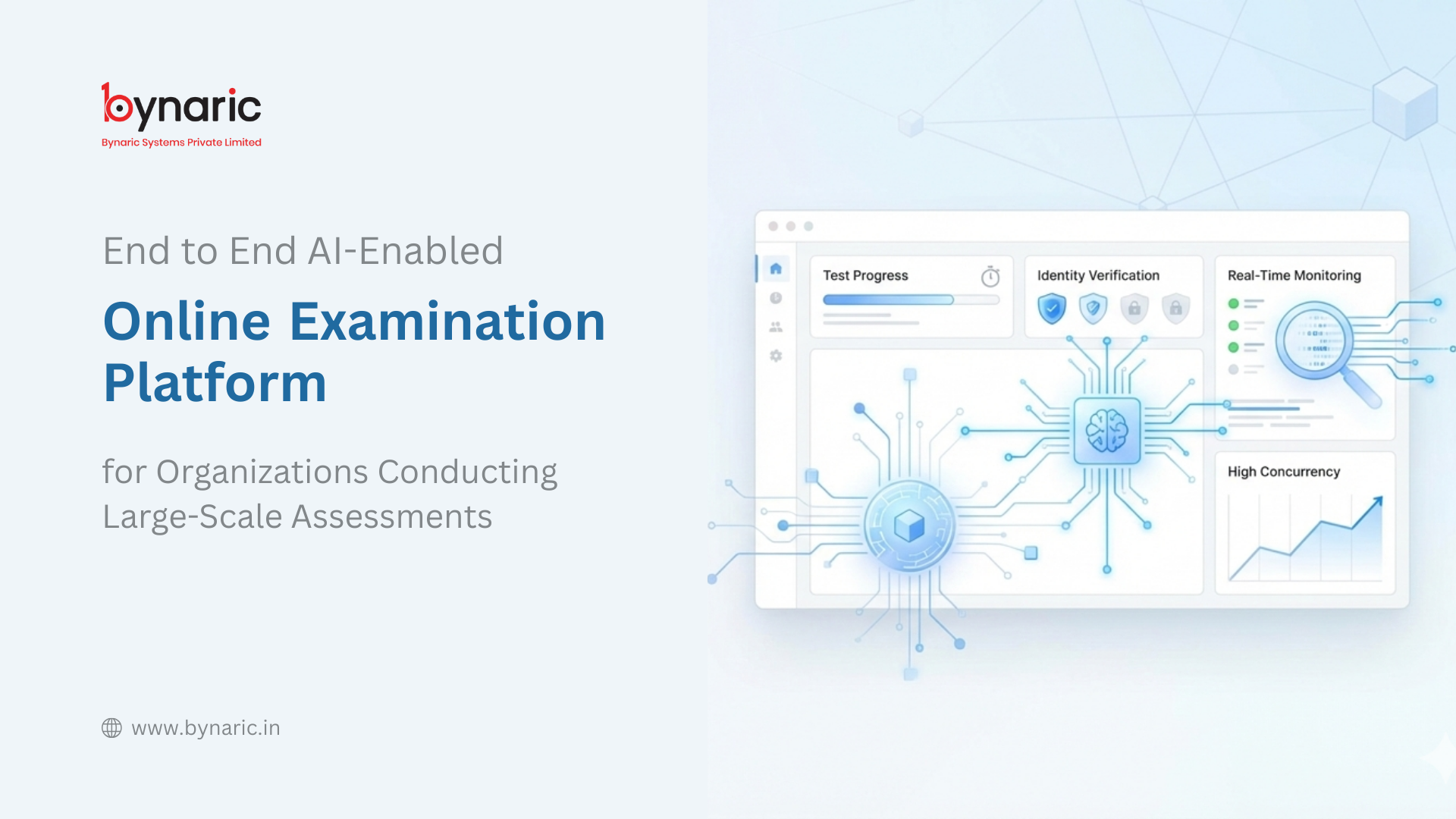
Organizations conducting large-scale assessments required a secure, scalable, and highly configurable online examination system capable of conducting remote and controlled assessments. Traditional exam systems lacked proctoring intelligence, navigation control, flexible evaluation logic, and scalability during peak examination cycles.
A full-featured Online Examination Platform was architected and deployed with AI-enabled proctoring, advanced exam control mechanisms, configurable scoring logic, and enterprise-grade security controls.
The platform supports high concurrency, real-time monitoring, flexible scheduling, and automated evaluation workflows.
Measurable Outcomes
- Secure remote examination capability with AI-based proctoring
- Reduced malpractice incidents through multi-layer security controls
- Automated result processing and instant score publishing
- Improved operational efficiency for examination departments
- High concurrency support during peak exam periods
- Reduced manual intervention in exam management
Performance & Scalability Validation
To ensure reliability during peak examination cycles, extensive load and performance testing was conducted.
Testing Outcomes:
- High concurrent user handling capability
- Stable system response under peak load conditions
- Minimal latency during exam submission workflows
- Zero data integrity issues under stress testing
- Consistent uptime during simulated large-scale exam scenarios
Load Testing Results Demonstrating High-Concurrency System Stability
Client Profile
The solution was designed for Organizations conducting large-scale assessments and academic boards responsible for:
- Conducting large-scale examinations
- Managing internal and external assessments
- Supporting objective and subjective testing formats
- Ensuring exam integrity and regulatory compliance
- Handling high student volumes during exam cycles
Problem Statement & System Constraints
Legacy examination processes suffered from:
- Limited remote proctoring capabilities
- High risk of malpractice in online settings
- Manual evaluation workflows
- Lack of flexible scoring and exam configuration
- Poor visibility into candidate activity
- Scalability challenges during peak exam sessions
- No centralized audit or monitoring mechanisms
Transformation Objective
To design and deploy a comprehensive online examination ecosystem that:
- Ensures exam integrity through AI-enabled monitoring
- Supports configurable exam structures and scoring models
- Enables secure remote and controlled environment testing
- Scales horizontally during high-volume exam events
- Reduces manual operational dependency
- Improves transparency and governance
Solution Architecture Overview
The platform was architected as a modular, secure assessment framework comprising:
- AI-Based Proctoring & Monitoring Engine
- Exam Integrity & Navigation Control Module
- Configurable Evaluation & Scoring Engine
- Test Structure & Scheduling Module
- Time Management & Accessibility Controls
- Role-Based Access & Collaboration System
Cloud Infrastructure Architecture
The platform is deployed on a secure, scalable cloud infrastructure designed to support high availability, fault tolerance, and peak examination workloads.
Key Infrastructure Capabilities:
- Auto-scalable compute environment
- Load-balanced application delivery
- Secure database hosting with backup mechanisms
- High availability and disaster recovery readiness
- Network-level security controls
AWS Cloud Infrastructure Architecture for High-Availability Examination Platform
Architecture Components
1. Proctoring & Security Layer
Designed to maintain examination integrity through automated monitoring:
- Candidate photo capture at periodic intervals
- Candidate screen capture to monitor desktop activity
- AI-enabled proctoring for automated anomaly detection
- Real-time monitoring dashboards
- Secure exam session management
This layer reduces dependency on manual invigilators while maintaining high compliance standards.
2. Exam Integrity & Navigation Control
Mechanisms implemented to prevent malpractice:
- Browser and tab-switch detection
- Configurable switch alert thresholds
- Automated penalty actions (e.g., forced logout)
- Dedicated Exam Launcher (Windows application) to restrict external access
- Controlled exam environment enforcement
This ensures controlled navigation and prevents unauthorized access during assessments.
3. Evaluation & Scoring Engine
Flexible and configurable scoring logic including:
- Instant score view post submission
- Question review before final submission
- Per-question mark visibility
- Customizable evaluation rules
- Objective and subjective assessment support
This enables institutions to define deterministic scoring models aligned with academic policies.
4. Test Structure & Scheduling Module
Designed to manage exam format and delivery:
- Option shuffle for MCQs
- Subjective exam support with single-file upload
- Student attendance auto-marking on exam initiation
- Configurable scheduling and exam windows
Ensures fair distribution of questions and structured exam control.
5. Time Management & Accessibility Controls
Supports diverse student requirements:
- Timer per question
- Real-time timer remaining notifications
- Extra time allocation for students requiring accommodations
- Configurable exam duration policies
This enables inclusive and policy-compliant examination management.
6. Collaboration & Access Control
Secure administrative and faculty controls:
- Test code-based access entry
- Role-based access management
- Collaborative question bank editing
- Centralized question repository
- Response clearing and answer modification controls
Improves institutional workflow efficiency and governance.
Implementation Methodology
The rollout followed a structured deployment approach:
- Requirement analysis and exam policy mapping
- Security architecture design
- Proctoring module configuration
- Question bank and scoring engine setup
- User role and permission configuration
- Performance testing for high concurrency scenarios
- UAT with institutional stakeholders
- Phased production rollout
- Post-deployment monitoring and optimization
Business & Operational Impact
- Secure 24×7 online examination capability
- Reduced physical infrastructure dependency
- Improved exam transparency and compliance
- Faster result declaration cycles
- Lower operational overhead
- Enhanced institutional credibility
Platform Benefits
- AI-enhanced exam integrity
- Scalable architecture for large institutions
- Configurable workflows without custom requirements
- Centralized monitoring and reporting
- Reduced manpower dependency
- Governance-ready audit mechanisms
Key Technical Insights
- Hybrid AI + rule-based monitoring improves exam security
- Configurable evaluation engines reduce long-term system rigidity
- Exam launcher and browser controls are critical for integrity
- Scalability planning must precede large-scale deployments
- Accessibility features are mandatory for regulatory compliance
Technology Stack
- Secured Web-Based Examination Platform
- AI-Enabled Proctoring Engine
- Real-Time Monitoring Dashboard
- Role-Based Access Control System
- Secure Backend & Database Architecture
- Scalable Cloud Infrastructure
Conclusion
This implementation demonstrates how Organizations conducting large-scale assessments can modernize assessment systems through AI-enabled proctoring, configurable evaluation logic, and scalable digital infrastructure.
The result is a secure, reliable, and governance-ready online examination platform capable of supporting high-volume academic operations with measurable efficiency gains.